
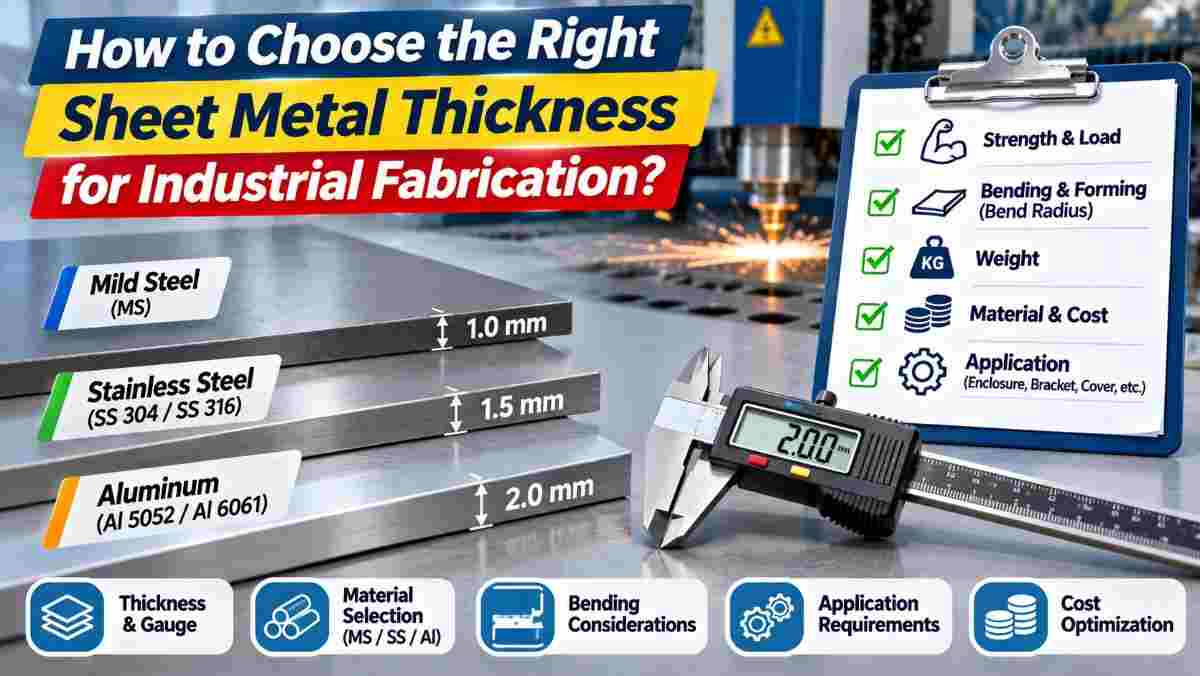
A sheet metal enclosure may look perfectly designed on a computer screen, but choosing the wrong material thickness can cause problems once fabrication begins. Thin sheets may bend or vibrate under load, while unnecessarily thick sheets can increase weight, material costs, and manufacturing difficulty.
For engineers, equipment manufacturers, and industrial buyers, selecting the correct sheet metal thickness for fabrication is an important decision that affects strength, durability, bending accuracy, and overall production costs.
The appropriate thickness depends on the material, part dimensions, loading conditions, manufacturing process, and intended application.
A small electrical enclosure may require a different sheet thickness than a heavy-duty machine bracket, even when both parts are manufactured from mild steel.
This guide explains how to evaluate sheet metal thickness, understand gauge measurements, and avoid common mistakes before starting fabrication.
Sheet metal thickness influences how a fabricated component performs during manufacturing and throughout its service life.
It affects bending behavior, stiffness, load-bearing capacity, material weight, and the amount of force required during forming.
If a sheet is too thin, it may experience excessive deflection, vibration, or local deformation.
If it is unnecessarily thick, it may increase manufacturing costs and require greater cutting or bending capacity.
The correct thickness should provide sufficient performance without adding unnecessary material.
Important factors include:
Structural strength and stiffness
Expected operating loads
Material weight
Bending and forming requirements
Welding and assembly methods
Corrosion protection
Manufacturing costs
Dimensional accuracy
For custom industrial components, thickness selection should be evaluated during the design stage rather than after production begins.
Vidhee Engineering provides sheet metal fabrication and engineering services for industrial components requiring accurate cutting, forming, and assembly.
Sheet metal gauge is a numbering system traditionally used to represent metal thickness.
In common gauge systems, a smaller gauge number indicates a thicker sheet, while a larger number indicates a thinner sheet.
For example, 14-gauge mild steel is thicker than 18-gauge mild steel under the same gauge standard.
However, gauge numbers do not represent identical thicknesses across all materials.
The thickness associated with a particular gauge can differ between mild steel, stainless steel, and aluminum.
For industrial fabrication, specifying actual thickness in millimeters helps avoid confusion.
Instead of requesting only 16-gauge sheet metal, an engineering drawing can state the required thickness and tolerance directly.
This is especially important for projects involving different material types or international suppliers.
A drawing should clearly identify:
Material grade
Nominal sheet thickness
Applicable thickness tolerance
Required surface condition
Relevant manufacturing specifications
For example, a drawing may specify a 1.5 mm cold-rolled mild steel sheet rather than relying only on a gauge number.
This provides clearer information for cutting, bending, and quality inspection.
Mild steel is commonly used in industrial sheet metal fabrication because it is relatively economical, readily available, and suitable for many cutting, bending, and welding operations.
The required thickness depends on the size and function of the component.
For example, thin mild steel sheets may be suitable for lightweight covers, while thicker sheets may be needed for brackets and machine supports.
Electrical enclosures are often manufactured using sheet thicknesses selected according to their dimensions, mounting arrangements, load requirements, and applicable product standards.
Some light-duty enclosure designs may use mild steel sheets around 1.0–1.5 mm thick, while larger or more demanding designs may require 2.0 mm or more.
These figures are illustrative starting points, not universal specifications.
Designers must also consider door stiffness, hinge loads, mounting hardware, and the weight of electrical components.
Industrial brackets may require thicker material because they transfer forces between equipment and supporting structures.
The correct thickness depends on:
Applied load
Bracket geometry
Unsupported span
Fastener arrangement
Bending stresses
Vibration and fatigue
Material strength
A bracket manufactured from 3 mm mild steel may be suitable for one application but inadequate for another.
Thickness should be confirmed through appropriate structural calculations and testing.
Stainless steel is frequently selected for fabricated components exposed to moisture, cleaning chemicals, or corrosive environments.
Common grades include SS 304 and SS 316.
Although stainless steel and mild steel can be manufactured in similar thicknesses, their mechanical properties and forming characteristics differ.
Austenitic stainless steels generally exhibit greater work hardening and springback during bending than many low-carbon mild steels.
This can affect:
Required bending force
Tool selection
Bend allowance
Inside bend radius
Dimensional accuracy
Surface protection during fabrication
Engineers should not assume that a design developed for mild steel can be manufactured from stainless steel without evaluating these differences.
For components requiring corrosion resistance, the appropriate stainless steel grade and thickness should be selected together.
Aluminum is commonly considered when reducing component weight is important.
Its lower density makes it attractive for certain equipment housings, transportation components, lightweight covers, and fabricated assemblies.
However, aluminum has a lower elastic modulus than steel, meaning an aluminum component of the same dimensions will generally be less stiff.
In some applications, yes.
A thicker aluminum sheet may be necessary to achieve stiffness comparable to a thinner steel component.
The final thickness depends on the selected alloy, temper, part geometry, and operating load.
Some aluminum alloys are also more sensitive to tight bending radii.
For example, 5052 aluminum generally offers better forming characteristics than 6061-T6 for applications involving relatively tight bends.
Material selection should therefore consider both fabrication requirements and the component's intended function.
Sheet thickness influences the laser cutting process, including cutting speed, energy requirements, edge quality, and production costs.
Thicker sheets generally require different cutting parameters than thinner materials.
The appropriate cutting setup also depends on the material and laser equipment.
Yes. CNC laser cutting can produce accurate profiles in many sheet metal thicknesses, provided the equipment and process are suitable.
However, dimensional accuracy and edge quality depend on several factors, including:
Material thickness and grade
Laser power
Cutting speed
Assist gas selection
Part geometry
Equipment condition
Thermal distortion
Very small holes, narrow slots, and closely spaced features may require special consideration as material thickness increases.
For precision components, engineers should review the design before manufacturing to confirm that the selected features can be produced consistently.
Vidhee Engineering's laser cutting services are relevant to industrial components requiring accurate profiles and repeatable fabrication.
Sheet thickness directly influences the force required to bend a component and the minimum bend radius that can be achieved without damaging the material.
Thicker sheets generally require greater forming force.
The achievable bend radius also depends on the material grade, temper, rolling direction, and press brake tooling.
The minimum bend radius is the smallest practical inside radius that can be formed without unacceptable cracking or damage.
For many mild steel applications, an inside bend radius around the material thickness is a common initial design consideration.
Stainless steel and some aluminum alloys may require larger radii depending on their properties.
For example, a 2 mm sheet may be designed with an initial 2 mm inside bend radius when the material and tooling permit it.
This is only a starting point. Final requirements should be confirmed through design-for-manufacturing review and relevant material guidance.
Bend allowance accounts for the length of material needed to form a bend.
It depends on the bend angle, material thickness, inside bend radius, and the location of the neutral axis.
Incorrect bend allowance calculations can cause finished parts to have the wrong flange lengths or overall dimensions.
This is especially important when manufacturing enclosures, folded brackets, and assemblies containing multiple bends.
Accurate CAD drafting and sheet metal development can help engineers prepare suitable flat patterns before production.
Estimating sheet metal weight helps engineers evaluate material consumption, shipping requirements, component handling, and overall product design.
For a simple flat rectangular sheet, the approximate weight can be calculated using:
Weight (kg) = Length (m) × Width (m) × Thickness (m) × Density (kg/m³)
For example, consider a mild steel sheet measuring:
Length: 1 meter
Width: 1 meter
Thickness: 2 mm
Approximate density: 7,850 kg/m³
The approximate weight is:
1 × 1 × 0.002 × 7,850 = 15.7 kg
If the thickness increases from 2 mm to 3 mm, the approximate weight increases to 23.55 kg.
That represents a 50% increase in material weight.
For bulk production, unnecessary thickness can significantly increase total material usage and transportation requirements.
Finished part weight may differ because of cutouts, bends, welded components, and other design features.
The correct sheet thickness depends on the intended application and the type of loads the fabricated component must resist.
Machine covers often need to provide protection without adding excessive weight.
Their design should consider panel size, vibration, mounting points, accidental contact, and any applicable machine guarding requirements.
Reinforcing ribs, folded edges, or supporting frames may improve stiffness without requiring a thicker sheet throughout the component.
Control panel enclosures require sufficient strength to support electrical components, doors, cable entries, and mounting hardware.
Engineers should consider the enclosure's dimensions, installation location, environmental protection rating, and relevant electrical equipment standards.
Larger panels may need reinforcement or thicker sheets to control deflection.
Brackets should be evaluated according to their loading conditions and geometry.
A small bracket supporting a lightweight sensor may require relatively thin material, while a bracket supporting heavy machinery may need substantially greater thickness or a different construction method.
The selected thickness should be supported by engineering calculations rather than general assumptions.
Selecting the appropriate thickness can reduce material consumption and simplify manufacturing without compromising the required performance.
Material costs often represent a significant portion of sheet metal fabrication expenses.
However, choosing the thinnest possible sheet is not always the most economical approach.
A thinner sheet may require additional reinforcement, welding, or complex forming operations to achieve the necessary stiffness.
Yes. Design-for-manufacturing improvements may help reduce costs by:
Selecting an appropriate sheet thickness
Reducing unnecessary material usage
Improving laser cutting nesting
Simplifying bend geometry
Standardizing material specifications
Reducing unnecessary machining
Minimizing additional welding operations
Designing parts for repeatable assembly
For example, a folded edge or reinforcing feature may improve the stiffness of a panel without increasing the thickness of the entire component.
The most economical option should consider the complete manufacturing process, not just the raw material price.
Incorrect thickness selection can lead to higher costs, manufacturing difficulties, and poor product performance.
Common mistakes include:
Selecting thickness only according to material price
Using gauge numbers without confirming actual thickness
Ignoring the difference between steel and aluminum stiffness
Failing to consider bending requirements
Overlooking vibration and fatigue loads
Using very thin sheets for large unsupported panels
Ignoring material thickness tolerances
Designing small features that are difficult to laser cut
Increasing thickness without evaluating alternative reinforcement methods
Failing to review the design with the fabricator before production
These issues can often be avoided through early collaboration between design engineers and fabrication teams.
A clear Request for Quotation (RFQ) helps the fabrication supplier understand the required material, geometry, manufacturing process, and quality expectations.
Before requesting a quotation, buyers should provide:
Material type and grade
Required sheet thickness
Applicable thickness tolerances
CAD drawings or 3D models
DXF files, where available
Bend angles and inside radii
Quantity per part
Required surface finish
Welding and assembly requirements
Dimensional tolerances
Delivery requirements
Buyers should also identify whether prototype approval is needed before bulk manufacturing.
Providing complete technical details reduces the possibility of quotation changes and production delays.
There is no single thickness suitable for all industrial applications. Many fabricated covers, enclosures, and brackets use materials within a broad range of approximately 1–3 mm, but actual requirements depend on the part design and operating conditions.
A 2 mm sheet may be suitable for some enclosures, panels, covers, and brackets. Its suitability depends on the material grade, component dimensions, loading conditions, and support arrangement.
Increasing thickness generally improves the stiffness and load capacity of a component when other factors remain constant. However, material grade, geometry, welding, and load distribution also influence performance.
Low-carbon mild steel and certain aluminum alloys offer good formability. Stainless steel can also be bent successfully, but springback and work hardening may require different tooling and forming parameters.
Yes. Thickness can affect laser cutting speed, energy consumption, assist gas requirements, and processing time. Part geometry and order quantity also influence the final cost.
Changing material thickness may affect bend allowance, flat patterns, hole clearances, assembly dimensions, and required tooling. The design should be reviewed and updated before manufacturing.
Selecting the correct material thickness is an important part of manufacturing durable, accurate, and cost-effective industrial components.
The best choice depends on the part's purpose, material properties, manufacturing requirements, and expected service conditions.
Vidhee Engineering, based in Navsari, Gujarat, provides industrial sheet metal fabrication, CNC laser cutting, press brake bending, CAD drafting, and engineering manufacturing services.
The company supports custom fabrication requirements for industrial equipment, enclosures, brackets, machine components, and other sheet metal products.
By reviewing material thickness, part geometry, fabrication methods, and production quantities before manufacturing, businesses can reduce avoidable design and production issues.
Need Help Choosing the Right Sheet Metal Thickness?
Contact Vidhee Engineering with your drawings, material specifications, required thickness, and production quantity to discuss your fabrication requirements.
A technical review during the design stage can help identify suitable materials and manufacturing approaches before prototype or bulk production.
Send your drawing, material and quantity to Vidhee Eng. Works, Navsari, and get a clear quotation with a delivery date.
Share your material, thickness and quantity — we’ll review it and come back with a quote and a delivery date, not just a price.