
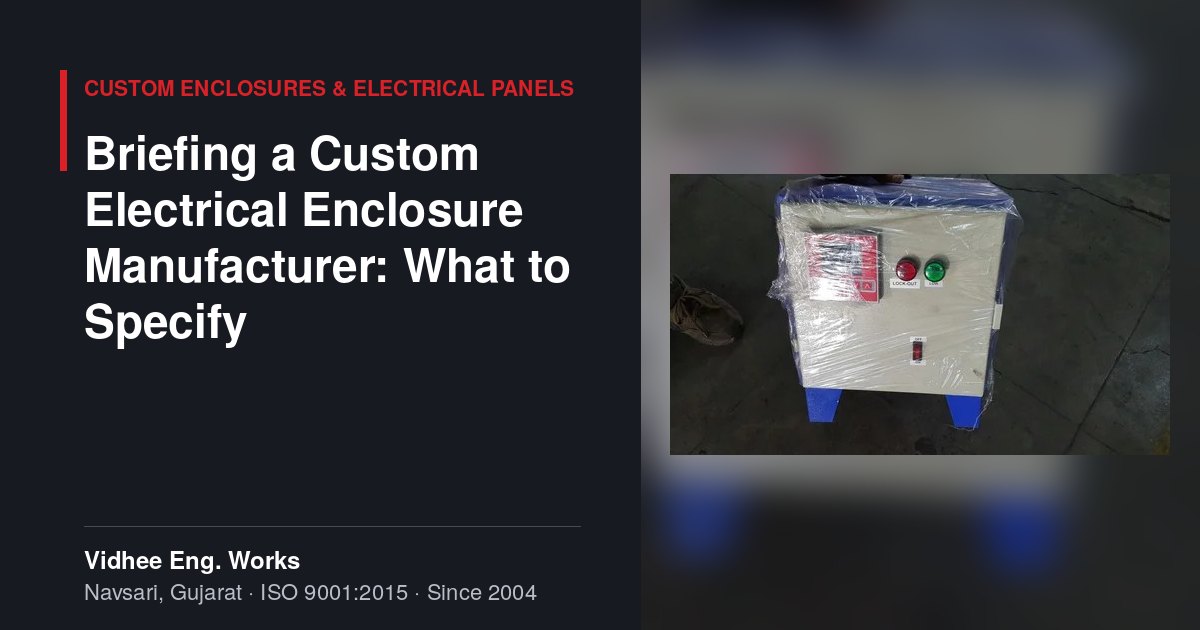
A standard catalogue enclosure rarely fits the exact mix of meters, switches, contactors and cable entries that a real control panel needs. A custom box solves that, but only if the specification is clear. This guide lists the points to settle before you send an enquiry to a custom electrical enclosure manufacturer.
Two pieces of information shape almost every other decision: the equipment list and the installation environment. List the components with their sizes, the mounting plate or DIN rail layout, and the heat they produce. Then describe the site: indoor control room, dusty shop floor, wash-down area, coastal outdoor location or a chemical plant.
A box for a clean electrical room can be simple and light. A box beside a pickling tank or exposed to monsoon rain needs a different material, sealing approach and finish. Getting this context up front avoids redesigns later.
It also helps to say who will open the panel and how often. A box that maintenance staff open daily needs easy-action locks and good internal access, while a box that stays closed for months can prioritise sealing and tamper resistance.
Most enclosures are made from one of three sheet materials. The table summarises where each is commonly used.
| Material | Strengths | Typical use | Points to note |
|---|---|---|---|
| CRCA (cold rolled mild steel) | Smooth surface, bends and welds well, economical | Indoor panels, machine control panels, MCB boxes | Needs powder coating or paint for corrosion protection |
| GI (galvanised iron) | Zinc coating gives built-in corrosion resistance | Semi-outdoor boxes, utility and distribution enclosures | Welding burns the zinc locally, so joints need touch-up |
| Stainless steel (304 or 316) | Corrosion resistant, hygienic, can be left uncoated | Food, pharma, chemical and coastal sites | Higher material cost; 316 suits more aggressive environments |
Thickness should be chosen for stiffness and the weight hung on the door and mounting plate, not only for cost. Small wall boxes are often made in thinner sheet, while large floor-standing panels, doors carrying heavy components and gland plates generally need heavier sheet or folded stiffeners. Your fabricator can suggest a thickness once the size and load are known.
Wall-mounted boxes suit smaller panels such as MCB boxes, push-button stations and local control panels. Specify the mounting method: back-wall holes, external mounting brackets or lugs, and the fixing hole spacing if it must match an existing wall or structure.
Floor-standing panels need a base frame or plinth so the cabinet sits level and cables can enter from below. State whether the panel stands alone, joins other sections side by side, or needs lifting eyes for installation. For machine panels, a pedestal or arm mounting may be required instead.
Provide the exact panel cut-out size from each component's datasheet, not the bezel size, along with the positions on the door. Meters, selector switches, push buttons, indicator lamps, HMIs and door-interlocked isolators each have their own cut-out shape. With CNC laser cutting, square, round and odd-shaped cut-outs can be made cleanly in the flat sheet before bending, which keeps them accurately placed.
Say where cables enter (top, bottom or side) and whether the gland plate should be removable, blank for site drilling, or pre-punched for specific gland sizes. A removable gland plate makes later changes far easier.
Heat from drives, transformers and power supplies has to escape. Pressed or laser-cut louvres, fan cut-outs with filters, and canopies are common options. Note that every opening affects protection against dust and water, so ventilation and sealing must be decided together.
IP (Ingress Protection) codes are defined in the international standard IEC 60529. The first digit, from 0 to 6, describes protection against solid objects and dust; the second, from 0 to 8 (later amendments add 9 for high-pressure, high-temperature water jets), describes protection against water. Some common examples:
An IP rating applies to the complete, assembled enclosure as tested, including gaskets, glands, cut-outs, fans and fitted components. A fabricated box can be designed and built with the sealing features intended for a target rating, but if a certified rating is required, the finished assembly should be tested by an accredited laboratory. Please state your target in the enquiry so that the enclosure design can include suitable gaskets, flanged openings and door construction.
Vidhee Eng. Works has fabricated panel boxes, MCB boxes, machine control panels and SS cabinets in Navsari, Gujarat since 2004, working under an ISO 9001:2015 certified quality system. Send us your drawing or component list through our contact page, and we will prepare a fabrication drawing for approval, with dispatch across India and export job work possible.
Send your drawing, material and quantity to Vidhee Eng. Works, Navsari, and get a clear quotation with a delivery date.
It depends on the site. Powder-coated CRCA works for sheltered locations, galvanised sheet gives better built-in corrosion resistance, and stainless steel suits coastal, chemical or wash-down areas. Grade 316 stainless steel is generally preferred where salt or aggressive chemicals are present. Sealing, a rain canopy and proper gaskets matter as much as the material itself.
No. IP ratings under IEC 60529 are confirmed by testing the complete assembled enclosure, usually at an accredited laboratory. Vidhee Eng. Works fabricates enclosures to your drawing, including the gaskets, flanged openings and door design intended for your target rating, but the formal rating depends on testing of the finished assembly with all components and glands fitted.
Share the outer size or the component list, material and thickness preference, wall or floor mounting, door and lock type, cut-out sizes and positions, cable entry and gland plate needs, ventilation requirements, earthing points, internal mounting plate or rails, finish colour and quantity. A DXF, DWG, STEP or PDF drawing helps, but a dimensioned sketch is also accepted.
Cutting door and panel cut-outs on a CNC laser while the sheet is still flat places them accurately relative to the edges and to each other, gives clean edges, and avoids the distortion that can come from cutting a formed box by hand. It also means the cut-outs repeat exactly on every enclosure in a batch, which helps when fitting standard components.
Share your material, thickness and quantity — we’ll review it and come back with a quote and a delivery date, not just a price.