
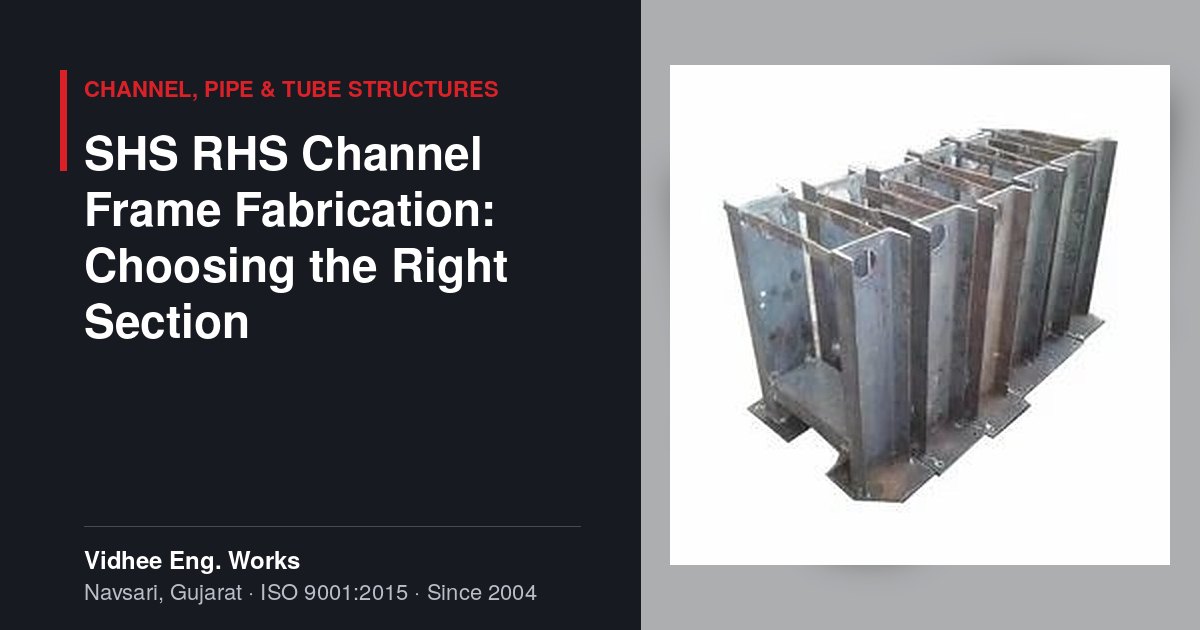
Most machine frames, stands, racks and platforms built in India use one of five steel sections: ISMC channel, angle, square hollow section (SHS), rectangular hollow section (RHS) or round pipe. Each one behaves differently under load, joins differently and looks different once painted. This guide sets out the trade-offs so that you can specify SHS RHS channel frame fabrication with a clear reason for every member, rather than defaulting to whatever was used on the last job.
ISMC (Indian Standard Medium Channel) is a hot-rolled C-section with tapered flanges. Angles are L-sections, available with equal or unequal legs. SHS and RHS are closed hollow sections, usually cold-formed and welded, with gently rounded corners. Round pipe, whether ERW tube or a circular hollow section, is the most efficient shape in torsion and the most awkward to cut and join. The table below gives a practical summary for typical frame work.
| Factor | ISMC channel | Angle | SHS | RHS | Round pipe |
|---|---|---|---|---|---|
| Bending stiffness per kg | Good about the major axis, poor about the minor axis | Low; suits light members and bracing | Good and equal in both directions | Very good about the deep axis | Good and equal in every direction |
| Torsional stiffness | Poor (open section) | Poor (open section) | Excellent | Very good | Excellent |
| Ease of joining | Easy to bolt through the web and flanges | Easy to bolt and weld; simple cleats | Easy square cuts and mitres; neat welds | Easy cuts; deep side suits brackets | Needs coped (fish-mouth) ends for branch joints |
| Appearance | Industrial, heavy | Utilitarian | Clean and modern | Clean and modern | Smooth, suits handrails |
| Corrosion protection | All faces reachable for paint | All faces reachable for paint | Inside needs sealing or galvanising | Inside needs sealing or galvanising | Inside needs sealing or galvanising |
| Typical use | Base frames, skids, long beams | Racks, bracing, light supports | Machine stands, tables, columns | Machine frames, platform beams, conveyors | Handrails, legs, guards |
Bending stiffness depends on how far the material sits from the neutral axis. A channel or RHS standing on edge puts most of its steel in the flanges, which is why it carries a deep load well. Turn the same member on its side and the stiffness falls sharply. When the direction of load is known and fixed, such as a floor beam on a platform, an ISMC or an RHS on edge gives you strength per kilogram that is hard to beat.
Machine frames rarely see one clean load direction. Motors start and stop, gearboxes react against the frame, and an operator leans on a corner. These loads twist the structure, and open sections such as channels and angles have very little resistance to twisting. Closed sections such as SHS, RHS and pipe can be many times stiffer in torsion than an open section of similar weight. If a frame wobbles or goes out of square when lifted, switching to a hollow section is often the simplest fix. Where channels are kept, placing them back to back or adding closely spaced cross members limits twist.
SHS and RHS are the easiest sections to fabricate into a neat welded frame. Square cuts and 45-degree mitres fit together cleanly, and a full-perimeter fillet weld seals the joint. Fit end caps on open ends to keep water and dirt out. For bolted connections on hollow sections, welded tabs or cleats are preferred over through-bolts, which can crush the walls unless sleeves are fitted.
Channels and angles suit bolted and site-assembled structures, because holes in a web or leg are easy to drill and reach. ISMC flanges are tapered, so bolts through the flange need taper washers to seat properly. Round pipe gives the best-looking handrails, but every branch joint needs a coped (fish-mouth) end so the pipes meet without gaps, which adds cutting and fit-up time.
Whatever the section, welding heat pulls frames out of square. A balanced weld sequence, tacking in a fixture and checking diagonals before final welding all help. Our welding and fabrication work uses MIG, TIG and stick welding depending on section thickness and finish required.
For a frame that customers will see, SHS and RHS give a clean, boxy look with no exposed edges. In washdown areas, closed sections with sealed ends and flat faces are easier to clean than channels and angles, whose inside corners and ledges collect residue.
On cost, compare the whole job rather than the price per kilogram of steel. Angles and channels are widely stocked and suit simple bolted designs. Hollow sections often need less steel and fewer stiffeners for the same stiffness, which can offset a higher material rate. Round pipe usually costs more in labour because of the profiled joints. Specifying sizes that local stockists commonly hold also avoids delays.
Open sections are simple to protect because every surface can be blasted or wire-brushed and painted. Closed sections are protected well on the outside but the inside is hidden. There are two sound approaches. Either seal the section completely with continuous welds and end caps, so no moisture can enter, or leave it open and use hot-dip galvanising, which coats the inside as well as the outside.
If galvanising is chosen, the design must include vent and drain holes at the ends of every enclosed member and at each internal joint, so molten zinc can flow through and trapped air can escape. Sealed sections must never be galvanised. For indoor machine frames, primer plus enamel or powder coating on a sealed hollow section is usually adequate. Painting, powder coating and galvanising can be arranged on request. For wet or chemical environments, stainless steel sections are worth comparing against a coated mild steel frame over the full service life.
Mixing sections is normal and sensible. A frame might use channel for the base, SHS for the uprights and pipe for the handrail. You can see examples of this kind of work on our channel, pipe and tube structures page.
Vidhee Eng. Works has fabricated structural frames, stands, trolleys and platforms in Navsari, Gujarat since 2004, under an ISO 9001:2015 certified quality management system, with dispatch across India by road and export job work supported. If you are deciding between channel, angle or hollow sections for a new frame, send us your drawing or sketch and we will review the section choice with you before quoting.
Send your drawing, material and quantity to Vidhee Eng. Works, Navsari, and get a clear quotation with a delivery date.
It depends on the loads. ISMC channel is efficient for long beams loaded in one direction and is easy to bolt. SHS and RHS resist twisting far better, so they suit frames carrying motors, gearboxes or vibrating units. Many base frames combine both: channel for the long side members and hollow sections for cross members and uprights.
During hot-dip galvanising the frame is dipped into molten zinc. Air or moisture trapped inside a sealed hollow section expands violently and can burst the member, and zinc cannot coat the inside. Vent and drain holes at the ends of each enclosed member let zinc flow through and air escape, protecting both the inside surface and the people at the galvanising plant.
Yes. Large platforms and frames are often designed in welded sub-assemblies joined by bolted flanges or cleats, so each piece fits on a truck and can be lifted into place on site. Channels and angles suit bolted joints well. Hollow sections can be bolted using welded end plates or tabs rather than through-bolting the walls.
Send a drawing as DXF, DWG, STEP or PDF, or a dimensioned sketch, with section sizes, material grade, quantity and the required finish such as primer, paint, powder coating or galvanising. Mention the load, how the frame will be lifted and installed, and any mounting holes for equipment. If sections are not yet decided, describe the duty and we can suggest options.
Share your material, thickness and quantity — we’ll review it and come back with a quote and a delivery date, not just a price.