
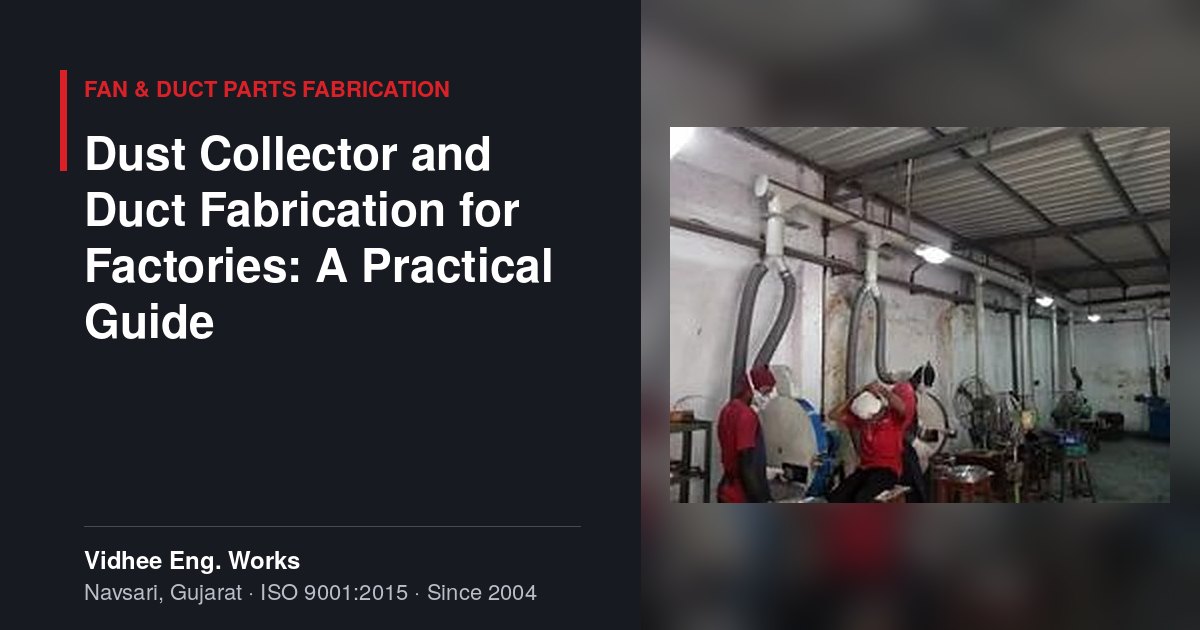
Dust from grinding, cutting, woodworking, powder handling and bagging is a health concern, a housekeeping cost and, for some materials, a fire risk. A well-built extraction system pulls dust away at the source and collects it in one place. This guide covers the main parts of a fabricated system and the details that help a fabricator build it correctly.
Every system, small or large, has the same basic chain:
Pipework, hoppers and supports are mostly fabricated from sheet and plate, so the quality of the fabrication shows directly in leaks, wear and how easily the system can be cleaned. Each part affects the others. A good collector cannot make up for hoods that miss the dust, and a strong fan cannot fix a duct that keeps choking.
The collector choice depends mainly on particle size, dust load and how clean the outlet air must be.
| Point | Cyclone | Bag filter |
|---|---|---|
| Working principle | Spinning airflow throws particles to the wall, where they fall to the hopper | Air passes through fabric bags that trap dust on their surface |
| Best for | Coarse and heavy dust, chips, sawdust, high dust loads | Fine dust and cases where cleaner outlet air is needed |
| Fine dust capture | Limited | Good, when bags suit the dust and temperature |
| Moving parts and consumables | None inside; simple to maintain | Bags and a cleaning system (often pulse-jet) need upkeep |
| Common arrangement | Used alone, or as a pre-cleaner | Used alone, or after a cyclone to protect the bags |
Many plants use a cyclone first to remove the bulk of coarse material, followed by a bag filter for fine dust. Local pollution control requirements should be checked when choosing the final collector.
Duct design decides whether air actually reaches every pick-up point. Some general principles:
Branches should join the main duct at a shallow angle, commonly around 30 to 45 degrees, and never at a straight 90-degree tee. A shallow entry merges the two streams smoothly and reduces turbulence and wear.
Use long-radius bends, often made as segmented (lobster-back) elbows, rather than sharp mitred corners. A centreline radius of around one and a half to two and a half duct diameters is a widely used rule of thumb. Sharp bends waste suction and wear out quickly with abrasive dust.
Changes of diameter or from round to rectangular should be gradual, with tapered transitions rather than sudden steps. The main duct grows in size as branches join, so that air speed stays fairly even.
If air slows down too much, dust drops out and builds up inside the duct. Duct sizes are chosen to keep a suitable conveying velocity for the dust type; heavier and stickier dusts need higher speeds. Avoid long horizontal runs where possible, provide clean-out doors at bends and junctions, and fit blast gates to balance branches.
Duct joints, flanges and supports depend on sound welding; our welding fabrication work covers the MIG, TIG and stick processes used for ductwork and collector bodies.
The fan is the heart of the system, and its impeller design should suit the air it handles.
Fan selection, including airflow and pressure, should come from a system calculation by a qualified ventilation or process engineer. The fabricator then builds the impeller, casing and ducts to that design. More on what we make is on our fan and duct parts fabrication page.
A clear enquiry leads to a better quote and fewer changes on site. Include:
For combustible dusts, ask your safety consultant about explosion venting, isolation and earthing before fabrication begins.
Vidhee Eng. Works fabricates duct layouts, dust collectors, cyclones and centrifugal and high pressure impellers in Navsari, Gujarat, and has worked in sheet metal since 2004 under an ISO 9001:2015 certified quality system. Send us your drawing or layout sketch through our contact page, and we will review it for fabrication, with dispatch across India by road and export job work possible.
Send your drawing, material and quantity to Vidhee Eng. Works, Navsari, and get a clear quotation with a delivery date.
A cyclone suits coarse, heavy dust and high dust loads, and has no internal moving parts. A bag filter captures much finer dust but needs bag replacement and a cleaning system. Many plants use both: a cyclone first to remove bulk material, then a bag filter for fine particles. The right choice depends on your dust and local emission requirements.
A shallow entry angle, commonly around 30 to 45 degrees, lets the branch airflow merge smoothly with the main stream. A 90-degree tee creates turbulence, wastes fan suction and can cause uneven extraction between pick-up points. Angled entries also reduce wear at the junction when the dust is abrasive.
Not on its own. Airflow and pressure depend on system design, hood design, duct sizing and fan selection, which should be calculated by a qualified ventilation or process engineer. Vidhee Eng. Works fabricates the collector, ducts and impellers to the design and drawings provided, and can help convert a layout sketch into fabrication drawings.
Describe the dust type and its behaviour, the number of pick-up points and the machines involved, and share a plant layout with heights and the collector location. Add any airflow and pressure data from your consultant, preferred material and thickness, indoor or outdoor installation, and finish. Drawings in DXF, DWG, STEP or PDF, or a clear sketch, are accepted.
Share your material, thickness and quantity — we’ll review it and come back with a quote and a delivery date, not just a price.