
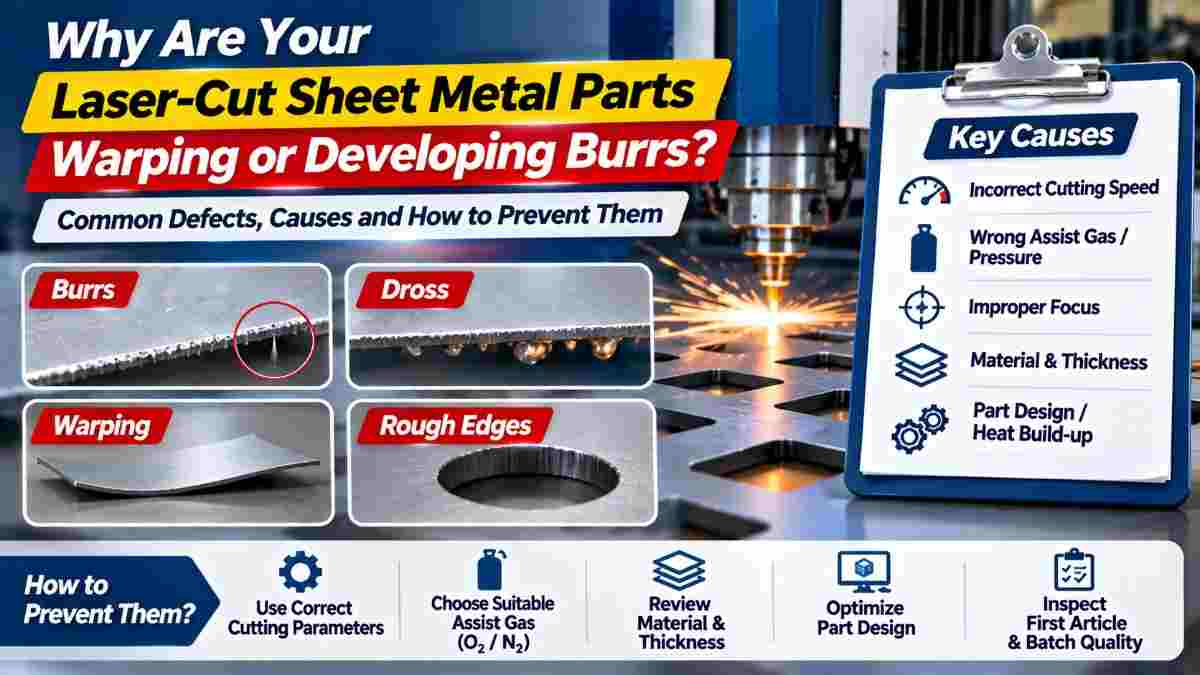
You receive a batch of laser-cut sheet metal components, but something is wrong. Some parts have rough edges, others have small metal deposits along the bottom, and a few thin panels no longer sit perfectly flat.
These problems may look minor, but they can create difficulties during bending, welding, assembly, and final inspection. For manufacturers ordering hundreds or thousands of identical components, even a small defect can increase finishing costs and delay production.
Common laser cutting defects in sheet metal include burrs, dross, warping, rough edges, and dimensional inaccuracies. These problems can result from incorrect cutting parameters, unsuitable assist gas, material characteristics, or part geometry.
The good news is that many defects can be reduced through proper machine setup, design review, and quality inspection.
This guide explains why laser-cut components develop these problems and how engineers, fabricators, and industrial buyers can prevent them.
Laser cutting defects are unwanted changes in a component's edge quality, surface condition, dimensions, or shape during the cutting process.
CNC laser cutting uses a focused laser beam to heat and remove material along a programmed path. An assist gas helps remove molten material from the cutting area.
When the laser beam, cutting speed, material, or gas flow is not properly matched, the finished part may develop defects.
Common problems include:
Burrs: Small projections or attached material along cut edges.
Dross: Solidified molten metal that remains attached to the underside of a cut.
Warping: Distortion that causes a sheet or component to lose its intended flatness.
Rough edges: Uneven cut surfaces with excessive striations or irregularities.
Incomplete cuts: Areas where the laser does not fully penetrate the material.
Dimensional inaccuracies: Finished dimensions that fall outside specified tolerances.
Edge discoloration: Oxidation or heat-related changes near the cutting zone.
Each defect has different possible causes, so identifying the visible problem is the first step toward choosing a suitable corrective action.
Burrs often form when molten material is not completely removed from the cutting zone.
During laser cutting, the beam melts or vaporizes material while an assist gas helps clear the kerf, which is the narrow opening created by the cut.
If molten metal remains attached to the lower edge and solidifies, it creates a burr or dross deposit.
Yes. Cutting speed influences how much energy is delivered to a given length of material.
If the speed is too high for the available laser power and material thickness, the beam may not maintain complete penetration or sufficient material removal.
If the speed is too low, excessive heating can increase molten material accumulation and affect edge quality.
The correct speed depends on material type, thickness, laser power, focus position, and assist gas.
Yes. Assist gas plays an important role in removing molten material from the kerf.
Insufficient gas flow may allow molten metal to remain attached to the bottom of the component.
However, excessive pressure or an unsuitable nozzle configuration can also interfere with stable cutting.
Operators should evaluate gas pressure together with cutting speed, nozzle condition, and focus settings.
Possible corrective measures include:
Reviewing cutting speed and laser power
Checking assist gas supply and pressure
Inspecting nozzle condition and alignment
Verifying the laser focus position
Confirming material thickness and grade
Testing approved cutting parameters on sample parts
Adjustments should follow equipment manufacturer guidance and the facility's validated procedures.
Dross is molten material that solidifies along the cut edge instead of being removed completely.
It often appears as hardened droplets or irregular deposits on the underside of a laser-cut component.
Dross can create assembly problems when parts must fit closely against another surface.
It may also require secondary grinding or deburring, increasing production time.
Possible causes include:
Incorrect laser focus position
Insufficient assist gas flow
Unsuitable cutting speed
Incorrect nozzle size
Nozzle misalignment
Material surface contamination
Incorrect settings for material thickness
Dross can occur in both oxygen-assisted and nitrogen-assisted cutting, although its characteristics may differ.
Yes. Depending on the material and the severity of the deposits, dross may be removed using suitable mechanical finishing methods.
However, removing dross after every cutting operation increases labor and handling costs.
For repetitive industrial production, preventing excessive dross is generally more efficient than relying on extensive secondary finishing.
Warping occurs when uneven heating and cooling cause a sheet metal component to distort.
Laser cutting concentrates heat in a narrow area, but some heat spreads into the surrounding material.
As the material heats and cools, thermal expansion and contraction can create internal stresses.
Thin sheets, narrow features, and components containing multiple closely spaced cuts can be particularly sensitive to these effects.
Excessive or uneven heat input can contribute to distortion, particularly when a small area receives repeated heating.
For example, cutting many narrow slots close together may concentrate heat in one section of a sheet.
This can cause the finished component to lift, twist, or lose flatness.
Part geometry plays an important role in heat distribution.
Designs containing long narrow sections, thin bridges, closely spaced holes, or dense perforations may be more sensitive to distortion.
The surrounding material provides less restraint in some of these geometries.
Common approaches include:
Optimizing the cutting sequence
Avoiding unnecessary heat concentration
Using appropriate cutting parameters
Improving sheet support
Reviewing the position of narrow features
Considering suitable holding tabs where necessary
Allowing for material-specific behavior
For components requiring strict flatness tolerances, engineers should discuss manufacturing feasibility before finalizing the design.
Laser-cut edges often contain fine lines called striations.
Some striations are a normal characteristic of laser cutting. However, deep or irregular marks may indicate unstable cutting conditions.
Excessive roughness can interfere with part appearance, dimensional requirements, or subsequent finishing operations.
Yes. Laser focus position affects the energy distribution within the cutting zone.
An unsuitable focus setting can result in poor penetration, excessive kerf width, rough edges, or dross.
The appropriate focus location depends on the material, thickness, cutting process, and equipment.
Yes. Rust, scale, coatings, oil, and other surface contaminants can interfere with the cutting process.
Material surface condition may affect heat absorption, gas flow, and edge quality.
For precision work, the sheet should meet the specified material and surface condition requirements.
Assist gas selection influences cutting performance, oxidation, edge appearance, and production cost.
The appropriate gas depends on the material and the finish required.
Oxygen is commonly used for laser cutting certain carbon steel materials.
Its reaction with heated steel can contribute additional energy to the cutting process.
However, oxygen cutting also produces an oxidized edge, which may require further preparation for some welding, coating, or finishing applications.
Nitrogen is commonly used when an oxidation-free or low-oxidation edge is important.
It is frequently selected for stainless steel and other applications requiring clean cut surfaces.
However, nitrogen cutting can involve different pressure, power, and operating cost requirements.
The most suitable gas should be selected according to material grade, sheet thickness, equipment capability, and final component requirements.
Material thickness influences the energy needed for complete penetration and the amount of molten metal that must be removed.
Thicker sheets generally require different cutting conditions than thin sheets.
For example, settings suitable for a 1.5 mm stainless steel sheet may not produce acceptable results on a 6 mm plate.
Similarly, a thin sheet may be more susceptible to thermal distortion than a thicker component of similar geometry.
Yes. Different metals have distinct thermal and optical properties.
Mild steel is commonly processed using oxygen or other suitable assist gases.
Stainless steel may require nitrogen when clean, low-oxidation edges are important.
Aluminum presents different challenges because of its thermal conductivity, reflectivity, alloy characteristics, and melting behavior.
Each material requires suitable machine settings and process controls.
Buyers should specify the actual material grade rather than simply requesting metal sheet cutting.
Even when CNC equipment is operating correctly, certain part geometries can create manufacturing difficulties.
Examples include small holes in thick material, narrow internal slots, closely spaced features, and sharp corners.
These features may require special piercing or cutting strategies.
Laser cutting machines may slow down when changing direction around sharp corners.
If the applied cutting energy is not adjusted appropriately, heat can accumulate near the corner.
This may create local overburning, rounded corners, or additional dross.
Yes. Very small holes relative to material thickness can be difficult to produce consistently.
Possible issues include poor circularity, tapered edges, dross, or incomplete penetration.
When precise small holes are necessary, additional drilling or another manufacturing process may be more appropriate.
A design-for-manufacturing review can identify features that are difficult to cut before production begins.
For example, engineers may adjust hole sizes, corner geometry, slot dimensions, or spacing without affecting the intended function.
This can reduce rejected parts and improve repeatability.
Quality inspection should confirm that the finished components meet the approved drawing and acceptance requirements.
Visual inspection alone may not identify every dimensional defect.
A practical inspection process should consider:
Cut edge condition
Burr and dross levels
Outside dimensions
Hole sizes and locations
Flatness and warping
Surface scratches or damage
Edge discoloration
Material identification
Quantity and batch consistency
For critical components, additional dimensional or surface-finish measurements may be required.
First-article inspection helps verify a newly manufactured part before full batch production.
It can identify dimensional or manufacturing problems before they affect hundreds of components.
This is particularly useful for parts with tight tolerances, multiple cutouts, or subsequent bending and welding operations.
Preventing defects in bulk manufacturing requires consistent processes, accurate drawings, and suitable quality controls.
A minor defect in one prototype can become a significant cost problem when repeated across a large production batch.
Manufacturers can reduce this risk by reviewing the design, confirming cutting parameters, and inspecting initial samples before production.
Important practices include:
Using accurate CAD or DXF files
Confirming material grade and thickness
Reviewing difficult cutting features
Maintaining machine optics and nozzles
Verifying cutting parameters
Using suitable assist gases
Conducting sample or first-article inspections
Monitoring quality during production
Documenting recurring defects
Buyers should also communicate whether minor edge marks, burrs, or heat discoloration are acceptable for the intended application.
Clear acceptance criteria help prevent disagreements during final inspection.
A detailed Request for Quotation helps the laser cutting supplier understand the component design and quality expectations.
Buyers should provide:
Material type and grade
Sheet thickness
DXF, DWG, STEP, or other suitable drawings
Required dimensions and tolerances
Quantity per part
Surface finish requirements
Acceptable burr or edge conditions
Flatness requirements, where relevant
Additional bending or welding requirements
Delivery schedule
For complicated components, providing an assembly drawing can help the supplier understand how the laser-cut parts will be used.
If the design requires tight tolerances or particular edge quality, these requirements should be discussed before production.
Burrs can form when molten material is not removed completely from the cutting zone. Incorrect focus, cutting speed, gas flow, or nozzle condition may contribute to the problem.
Burrs are unwanted edge projections, while dross generally refers to resolidified molten material attached to the cut. In laser cutting, the terms are sometimes used interchangeably for deposits along the lower edge.
Yes. Thin stainless steel sheets may experience thermal distortion when heat is concentrated unevenly. Part design, cutting sequence, material condition, and process parameters all influence the risk.
Nitrogen is often preferred when minimizing oxidation is important, particularly for stainless steel. Oxygen may be more suitable for certain carbon steel cutting applications. The best choice depends on the material and production requirements.
Many defects can be substantially reduced, but no manufacturing process is entirely free from variation. Appropriate tolerances, equipment setup, process validation, and inspection help achieve consistent quality.
Not always. Properly processed laser-cut components may be suitable for direct assembly. However, some applications require deburring, edge preparation, polishing, or other finishing operations.
For industrial manufacturers, reliable laser cutting involves more than producing the correct shape. Components must also meet dimensional requirements, provide suitable edge quality, and remain consistent across production batches.
Vidhee Eng. Works, based in GIDC Kabilpore, Navsari, Gujarat, provides CNC fiber laser cutting and related sheet metal fabrication services.
The company works with mild steel, stainless steel, aluminum, and other supported metals for industrial components such as brackets, machine covers, electrical enclosure parts, mounting plates, and custom profiles.
Its manufacturing services also include CNC press brake bending, welding, and fabrication, allowing customers to coordinate multiple production requirements.
For projects where flatness, edge finish, dimensional accuracy, or material utilization are important, a drawing review before production can help identify potential manufacturing challenges.
Need Precision Laser Cutting for Your Sheet Metal Components?
Contact Vidhee Eng. Works with your material grade, sheet thickness, technical drawings, quantity, and quality requirements to discuss your project.
Reviewing these details before fabrication can help reduce rework, improve consistency, and support smoother production.
Send your drawing, material and quantity to Vidhee Eng. Works, Navsari, and get a clear quotation with a delivery date.
Share your material, thickness and quantity — we’ll review it and come back with a quote and a delivery date, not just a price.