
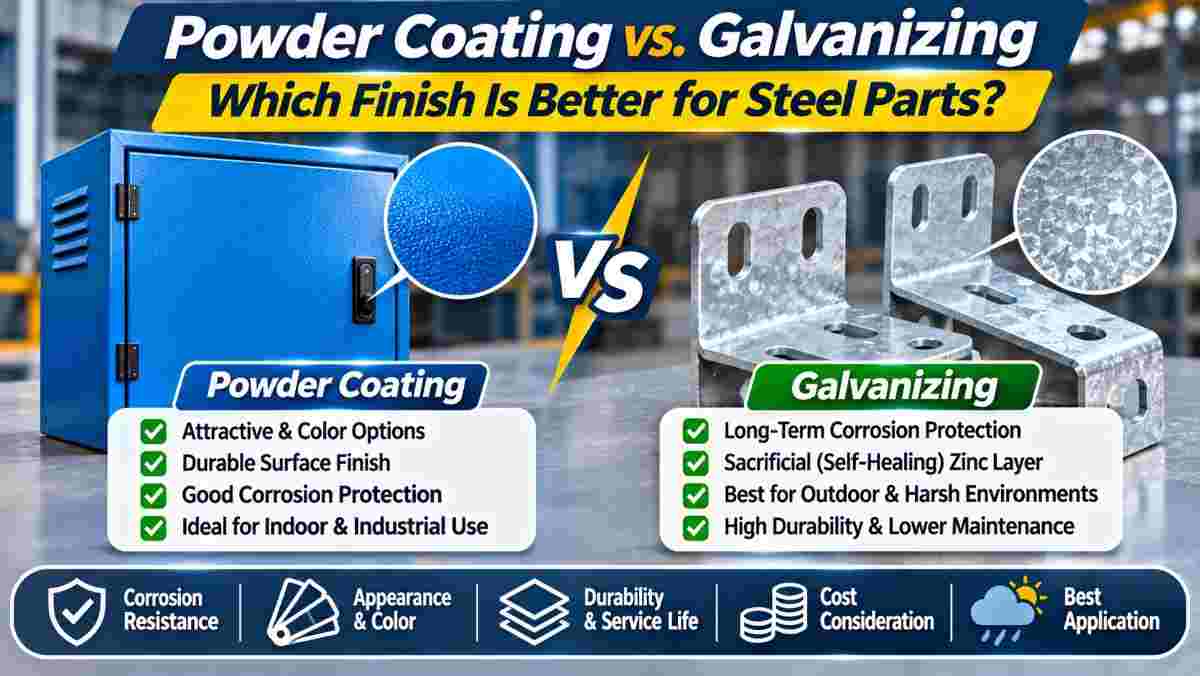
You have finalized the design of an industrial enclosure, machine frame, or steel bracket. The cutting, bending, and welding requirements are clear, but one important decision remains: how should the finished component be protected from corrosion?
Some buyers request powder coating because they want an attractive, uniform finish. Others prefer galvanizing because the components will be installed outdoors or exposed to moisture.
Both methods can protect fabricated steel, but they work differently.
Powder coating vs. galvanizing is not simply a comparison of appearance or price. The right choice depends on environmental exposure, component design, expected service life, maintenance requirements, and manufacturing costs.
Powder coating provides a protective organic barrier and offers a wide range of colors and finishes. Hot-dip galvanizing applies a zinc coating that provides both barrier protection and sacrificial corrosion protection.
For industrial buyers, understanding these differences can help prevent premature rusting, coating failures, and unnecessary maintenance expenses.
This guide explains how both finishing methods work and when each is suitable for fabricated steel components.
The main difference between powder coating and galvanizing is how they protect the underlying steel.
Powder coating forms an organic protective layer over the metal surface. Hot-dip galvanizing creates a zinc coating that is metallurgically bonded to the steel.
Both methods can reduce exposure to moisture and corrosive substances, but galvanized zinc can also provide sacrificial protection when small areas of underlying steel become exposed.
Powder coating is a dry finishing process in which electrically charged powder particles are applied to a prepared metal surface.
The coated component is then heated according to the powder manufacturer's curing requirements, allowing the coating to form a continuous protective layer.
The finished coating can provide:
A uniform surface appearance
A wide choice of colors
Different gloss and texture options
Resistance to ordinary handling and abrasion
Protection against environmental exposure
An attractive finish for industrial equipment
The level of corrosion protection depends on surface preparation, pretreatment, powder chemistry, coating thickness, and operating conditions.
For example, a properly specified polyester powder coating system may be suitable for exterior components, while other powder formulations are intended primarily for indoor use.
Hot-dip galvanizing involves immersing properly prepared steel components in molten zinc.
The process creates zinc-iron alloy layers and an outer zinc layer that protect the underlying steel.
Unlike powder coating alone, hot-dip galvanizing provides both barrier protection and sacrificial protection.
This means that the zinc can help protect exposed steel around small coating defects or scratches.
Galvanizing is commonly used for structural steel components, support frames, outdoor brackets, and other fabricated parts requiring long-term corrosion protection.
Powder coating is often preferred when appearance, color consistency, and a smooth finished surface are important.
It is commonly considered for indoor industrial equipment, electrical enclosures, machinery covers, control panels, and fabricated housings.
Yes. Powder coating is widely used for steel electrical enclosures because it provides an attractive finish and can offer suitable corrosion resistance when properly specified.
Manufacturers may select different colors for equipment identification, branding, or workplace requirements.
However, the finish alone does not determine whether an enclosure is suitable for indoor or outdoor installation.
The enclosure's sealing, drainage, material, coating system, and required environmental protection rating must also be considered.
Powder coating can be a practical option for machine covers and equipment housings, particularly where components are installed in controlled industrial environments.
It can provide a durable surface that is easier to clean and maintain than untreated mild steel.
For components exposed to abrasion, chemicals, or frequent impact, the coating system should be selected according to the actual operating conditions.
The principal limitation is that powder coating applied directly to steel relies mainly on barrier protection.
If the coating is damaged and moisture reaches the underlying metal, corrosion may begin.
Improper surface preparation can also result in poor adhesion, blistering, or premature coating failure.
For this reason, powder coating quality depends on more than the visible finish.
Galvanizing is commonly selected when long-term corrosion protection is more important than achieving a particular decorative appearance.
It is especially useful for components exposed to rain, humidity, and outdoor atmospheric conditions.
Hot-dip galvanizing is often a strong choice for outdoor steel structures because its zinc coating provides long-term protection against atmospheric corrosion.
Typical applications include:
Outdoor steel support frames
Industrial platforms and brackets
Structural components
Equipment mounting structures
Cable support systems
Outdoor machinery supports
Actual coating life depends on atmospheric corrosivity, zinc coating thickness, local conditions, and component design.
Coastal and heavily polluted industrial environments may require additional protection.
Yes. Zinc provides sacrificial protection to adjacent exposed steel when small areas of the coating are damaged.
This can help limit corrosion around minor scratches.
However, the protection is not unlimited. Large exposed areas, severe abrasion, or highly aggressive environments can still result in corrosion.
Hot-dip galvanizing may not provide the smooth, colored appearance required for certain industrial products.
The process also introduces manufacturing considerations, including:
Component size and galvanizing bath limitations
Ventilation and drainage requirements
Potential distortion of thin or asymmetrical fabrications
Coating buildup around holes and threads
Surface appearance variations
Appropriate design of enclosed sections
These factors should be reviewed during the fabrication design stage.
For many exposed outdoor steel applications, hot-dip galvanizing provides more forgiving corrosion protection than a basic single-layer powder coating applied directly to steel.
However, it would be incorrect to assume that every galvanized component will outperform every powder-coated component.
A properly engineered multi-layer powder coating system may perform well in demanding environments.
The result depends on coating quality, pretreatment, thickness, and environmental exposure.
Both systems can protect steel in humid environments when properly applied.
For a typical indoor facility with controlled humidity, a suitable powder coating system may provide adequate protection.
For outdoor installations exposed to repeated wetting, galvanized steel may offer advantages because of its zinc-based protection.
Coastal environments can accelerate corrosion because airborne chlorides increase atmospheric corrosivity.
Hot-dip galvanizing is commonly used in such conditions, but coating thickness and environmental severity must be evaluated.
For severe coastal exposure, a duplex system combining galvanizing and an additional protective topcoat may be preferable.
The final selection should follow the project's service-life and corrosion-protection requirements.
Yes. Powder coating can be applied over properly prepared hot-dip galvanized steel.
This combination is called a duplex coating system.
The galvanized layer provides zinc-based corrosion protection, while the powder coating adds another protective barrier and allows the component to have a specified color or appearance.
Duplex systems are often considered when both corrosion resistance and appearance are important.
Applications may include:
Outdoor electrical equipment
Coastal industrial structures
Architectural steel components
Outdoor machinery enclosures
Industrial railings and support structures
Color-coded safety equipment
The two coatings can complement each other by reducing exposure of the zinc layer to the environment while retaining the corrosion protection benefits of galvanizing.
No. Appropriate surface preparation is essential.
The galvanized surface may require cleaning, suitable pretreatment, and other preparation steps before powder application.
Surface contamination and outgassing during curing can cause blistering, pinholes, or adhesion problems.
ASTM D7803 provides guidance for preparing hot-dip galvanized iron and steel surfaces for powder coating.
Buyers should confirm that the coating contractor has experience with duplex coating systems.
The more economical option depends on the component dimensions, batch quantity, finishing specification, and expected maintenance requirements.
Powder coating may be cost-effective for fabricated equipment requiring a consistent colored finish.
Hot-dip galvanizing may provide better long-term value for outdoor components where corrosion protection and reduced maintenance are priorities.
Important cost factors include:
Component dimensions and surface area
Surface preparation requirements
Powder type and color
Coating thickness
Batch quantity
Masking requirements
Curing and handling requirements
Complex parts requiring multiple coats or special pretreatment may cost more than straightforward components.
Galvanizing costs depend on:
Component weight and dimensions
Steel composition
Required coating specifications
Fabrication complexity
Vent and drainage arrangements
Handling requirements
Transportation to the galvanizing facility
For bulky components, transportation and handling can become significant cost factors.
The initial finishing price does not represent the entire cost of protecting a steel component.
Buyers should also consider maintenance, repair access, potential replacement costs, and expected operating life.
For example, a relatively inexpensive finish may become costly if outdoor equipment requires frequent repainting.
A higher initial investment in an appropriate corrosion-protection system may reduce future maintenance expenses.
The best approach is to compare the complete expected cost over the component's intended service life.
Finishing requirements should be considered before cutting, bending, and welding begin.
A design that is easy to fabricate may still be difficult to coat correctly.
Powder coating requires suitable access to the surfaces being coated.
Deep recesses, narrow gaps, and complex corners may create challenges for uniform coverage.
Engineers should consider:
Hanging and handling points
Adequate drainage after pretreatment
Coating accessibility
Thread and mating-surface masking
Required clearances after coating
Suitable surface preparation
The design should also account for the effect of coating thickness on close-fitting assemblies.
Hot-dip galvanizing requires particular attention to component geometry.
Hollow sections and enclosed spaces may need appropriately positioned vent and drainage openings to allow safe processing.
Designers should also consider distortion risks and coating buildup near precision features.
Where the part includes tight-tolerance holes or threads, suitable post-galvanizing processing or masking arrangements may be necessary.
A fabrication and finishing review can identify these requirements before production.
The following examples illustrate how the intended use influences finishing selection.
A properly specified powder coating system is commonly used for indoor electrical panels and control enclosures.
It offers a uniform appearance and a choice of colors while protecting the underlying steel in suitable environments.
Hot-dip galvanizing may be preferable for outdoor steel brackets exposed to weather, particularly when appearance is a secondary consideration.
Powder coating is often suitable for machine covers requiring a clean, durable industrial finish.
The correct system depends on exposure to moisture, chemicals, abrasion, and operational temperatures.
Galvanizing or a properly engineered duplex coating system may provide improved corrosion protection for coastal installations.
The final choice should be confirmed according to environmental severity and intended service life.
Finishing-related problems often result from selecting a coating without considering the conditions in which the component will operate.
Common mistakes include:
Choosing a finish only by its initial price
Using indoor-grade powder coating for outdoor equipment
Ignoring surface preparation requirements
Assuming all galvanized coatings provide identical durability
Failing to consider corrosion around cut edges or damaged areas
Overlooking galvanizing vent and drainage requirements
Forgetting coating thickness when designing precision assemblies
Specifying a duplex system without confirming galvanized-surface preparation
Ignoring the need for future maintenance
These problems can often be prevented by discussing finishing requirements during the initial design review.
A clear Request for Quotation helps a fabrication supplier understand the component, service environment, and expected finish.
Before requesting a quotation, buyers should provide:
Material grade and sheet thickness
Component drawings and dimensions
Intended indoor or outdoor use
Exposure to moisture, chemicals, or salt
Required powder coating or galvanizing specification
Color and gloss requirements, if applicable
Coating thickness or performance requirements
Areas requiring masking
Batch quantity
Inspection requirements
Delivery schedule
If a specific coating standard applies, it should be stated directly.
For hot-dip galvanized fabricated steel, ASTM A123/A123M may be relevant. ASTM D7803 addresses surface preparation before powder coating over hot-dip galvanized steel.
The appropriate specifications depend on the type of product and coating process.
Neither method is universally better. Powder coating is useful when appearance, color, and a suitable protective finish are priorities. Galvanizing often offers advantages for long-term corrosion protection of outdoor steel components.
Yes. If the coating is damaged, poorly applied, or unsuitable for the operating environment, moisture may reach the steel and cause corrosion.
Not always. Hot-dip galvanizing can provide substantial corrosion protection on its own. Additional coating may be beneficial where appearance requirements or severe environmental conditions justify it.
Yes. A properly prepared galvanized surface can be powder coated to create a duplex protection system. Correct pretreatment and curing procedures are important for good adhesion.
Powder coating is commonly selected for electrical enclosures because of its uniform appearance and available colors. Outdoor or corrosive environments may require a more demanding coating system or a different substrate.
It can be, but thin fabricated components may be more susceptible to distortion during batch hot-dip galvanizing. Engineers should review part geometry, steel suitability, and finishing requirements before selecting the process.
Choosing the correct finish is an important part of manufacturing reliable industrial steel components.
Whether a project involves electrical enclosures, machine covers, brackets, or outdoor structures, corrosion protection should be evaluated alongside material selection, cutting, bending, and welding.
Vidhee Eng. Works, based in Navsari, Gujarat, provides custom sheet metal fabrication, CNC laser cutting, press brake bending, welding, and related manufacturing services.
The company supports industrial fabrication projects involving mild steel, stainless steel, aluminum, and galvanized sheet.
For projects requiring powder coating, galvanizing, painting, or plating, customers can specify the required finish during the quotation stage so that the fabrication and finishing requirements can be evaluated together.
Need Custom Fabricated Steel Parts With the Right Surface Finish?
Contact Vidhee Eng. Works with your drawings, material specifications, intended operating environment, finishing requirements, and production quantity.
Choosing an appropriate finishing method during the design stage can help reduce corrosion risks, unnecessary manufacturing costs, and future maintenance problems.
Share your material, thickness and quantity — we’ll review it and come back with a quote and a delivery date, not just a price.